super

super keyword in java

The super keyword in java is a reference variable which is used to refer immediate parent class object.
Whenever you create the instance of subclass, an instance of parent class is created implicitly which is referred by super reference variable.

Usage of java super Keyword

  1. super can be used to refer immediate parent class instance variable.
  2. super can be used to invoke immediate parent class method.
  3. super() can be used to invoke immediate parent class constructor.

1) super is used to refer immediate parent class instance variable.

We can use super keyword to access the data member or field of parent class. It is used if parent class and child class have same fields.
class Animal{  
String color="white";  
}  
class Dog extends Animal{  
String color="black";  
void printColor(){  
System.out.println(color);//prints color of Dog class  
System.out.println(super.color);//prints color of Animal class  
}  
}  
class TestSuper1{  
public static void main(String args[]){  
Dog d=new Dog();  
d.printColor();  
}}  
Output:
black
white
In the above example, Animal and Dog both classes have a common property color. If we print color property, it will print the color of current class by default. To access the parent property, we need to use super keyword.

2) super can be used to invoke parent class method

The super keyword can also be used to invoke parent class method. It should be used if subclass contains the same method as parent class. In other words, it is used if method is overridden.
class Animal{  
void eat(){System.out.println("eating...");}  
}  
class Dog extends Animal{  
void eat(){System.out.println("eating bread...");}  
void bark(){System.out.println("barking...");}  
void work(){  
super.eat();  
bark();  
}  
}  
class TestSuper2{  
public static void main(String args[]){  
Dog d=new Dog();  
d.work();  
}}  

Output:
eating...
barking...
In the above example Animal and Dog both classes have eat() method if we call eat() method from Dog class, it will call the eat() method of Dog class by default because priority is given to local.
To call the parent class method, we need to use super keyword.

3) super is used to invoke parent class constructor.

The super keyword can also be used to invoke the parent class constructor. Let's see a simple example:
class Animal{  
Animal(){System.out.println("animal is created");}  
}  
class Dog extends Animal{  
Dog(){  
super();  
System.out.println("dog is created");  
}  
}  
class TestSuper3{  
public static void main(String args[]){  
Dog d=new Dog();  
}} 
Output:
animal is created
dog is created

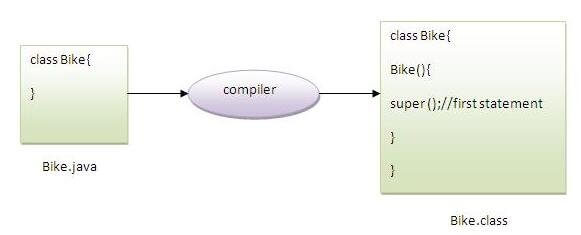
Note: super() is added in each class constructor automatically by compiler if there is no super() or this().

java super
As we know well that default constructor is provided by compiler automatically if there is no constructor. But, it also adds super() as the first statement.
Another example of super keyword where super() is provided by the compiler implicitly.
 class Animal{  
Animal(){System.out.println("animal is created");}  
}  
class Dog extends Animal{  
Dog(){  
System.out.println("dog is created");  
}  
}  
class TestSuper4{  
public static void main(String args[]){  
Dog d=new Dog();  
}} 

Output:
animal is created
dog is created

super example: real use

Let's see the real use of super keyword. Here, Emp class inherits Person class so all the properties of Person will be inherited to Emp by default. To initialize all the property, we are using parent class constructor from child class. In such way, we are reusing the parent class constructor.
class Person{  
int id;  
String name;  
Person(int id,String name){  
this.id=id;  
this.name=name;  
}  
}  
class Emp extends Person{  
float salary;  
Emp(int id,String name,float salary){  
super(id,name);//reusing parent constructor  
this.salary=salary;  
}  
void display(){System.out.println(id+" "+name+" "+salary);}  
}  
class TestSuper5{  
public static void main(String[] args){  
Emp e1=new Emp(1,"ankit",45000f);  
e1.display();  
}}  

Output:
1 ankit 45000

covariant

Covariant Return Type

The covariant return type specifies that the return type may vary in the same direction as the subclass.
Before Java5, it was not possible to override any method by changing the return type. But now, since Java5, it is possible to override method by changing the return type if subclass overrides any method whose return type is Non-Primitive but it changes its return type to subclass type. Let's take a simple example:

Note: If you are beginner to java, skip this topic and return to it after OOPs concepts.


Simple example of Covariant Return Type

  1. class A{  
  2. A get(){return this;}  
  3. }  
  4.   
  5. class B1 extends A{  
  6. B1 get(){return this;}  
  7. void message(){System.out.println("welcome to covariant return type");}  
  8.   
  9. public static void main(String args[]){  
  10. new B1().get().message();  
  11. }  
  12. }  

Output:welcome to covariant return type

As you can see in the above example, the return type of the get() method of A class is A but the return type of the get() method of B class is B. Both methods have different return type but it is method overriding. This is known as covariant return type.

overriding

Method Overriding

If subclass (child class) has the same method as declared in the parent class, it is known as method overriding in java.
In other words, If subclass provides the specific implementation of the method that has been provided by one of its parent class, it is known as method overriding.

Usage of Java Method Overriding

  • Method overriding is used to provide specific implementation of a method that is already provided by its super class.
  • Method overriding is used for runtime polymorphism

Rules for Java Method Overriding

  1. method must have same name as in the parent class
  2. method must have same parameter as in the parent class.
  3. must be IS-A relationship (inheritance).

Understanding the problem without method overriding

Let's understand the problem that we may face in the program if we don't use method overriding.
  1. class Vehicle{  
  2.   void run(){System.out.println("Vehicle is running");}  
  3. }  
  4. class Bike extends Vehicle{  
  5.     
  6.   public static void main(String args[]){  
  7.   Bike obj = new Bike();  
  8.   obj.run();  
  9.   }  
  10. }  

Output:Vehicle is running


Problem is that I have to provide a specific implementation of run() method in subclass that is why we use method overriding.

Example of method overriding

In this example, we have defined the run method in the subclass as defined in the parent class but it has some specific implementation. The name and parameter of the method is same and there is IS-A relationship between the classes, so there is method overriding.
  1. class Vehicle{  
  2. void run(){System.out.println("Vehicle is running");}  
  3. }  
  4. class Bike2 extends Vehicle{  
  5. void run(){System.out.println("Bike is running safely");}  
  6.   
  7. public static void main(String args[]){  
  8. Bike2 obj = new Bike2();  
  9. obj.run();  
  10.  

Output:Bike is running safely

Real example of Java Method Overriding

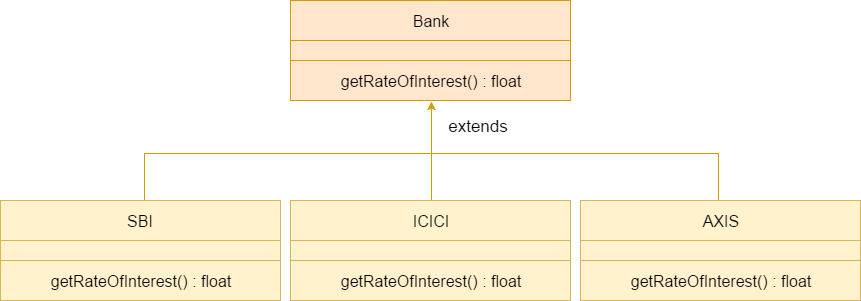
Consider a scenario, Bank is a class that provides functionality to get rate of interest. But, rate of interest varies according to banks. For example, SBI, ICICI and AXIS banks could provide 8%, 7% and 9% rate of interest.
Java method overriding example of bank
  1. class Bank{  
  2. int getRateOfInterest(){return 0;}  
  3. }  
  4.  
  5. class SBI extends Bank{  
  6. int getRateOfInterest(){return 8;}  
  7. }  
  8.   
  9. class ICICI extends Bank{  
  10. int getRateOfInterest(){return 7;}  
  11. }  
  12. class AXIS extends Bank{  
  13. int getRateOfInterest(){return 9;}  
  14. }  
  15.   
  16. class Test2{  
  17. public static void main(String args[]){  
  18. SBI s=new SBI();  
  19. ICICI i=new ICICI();  
  20. AXIS a=new AXIS();  
  21. System.out.println("SBI Rate of Interest: "+s.getRateOfInterest());  
  22. System.out.println("ICICI Rate of Interest: "+i.getRateOfInterest());  
  23. System.out.println("AXIS Rate of Interest: "+a.getRateOfInterest());  
  24. }  
  25. }  

Output:
SBI Rate of Interest: 8
ICICI Rate of Interest: 7
AXIS Rate of Interest: 9

Can we override static method?

No, static method cannot be overridden. It can be proved by runtime polymorphism, so we will learn it later.

Why we cannot override static method?

because static method is bound with class whereas instance method is bound with object. Static belongs to class area and instance belongs to heap area.

Can we override java main method?

No, because main is a static method.